
PAST // BACHELOR
PAST // M1.1
PRESENT
FUTURE
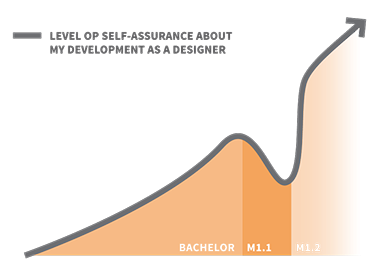
I ended the bachelors with the feedback that I should reconsider my presumed analytical attitude and think about myself as a more hands-on, practical designer. In the way I reflected on my activities I did not gave the impression that I had analytical ambition since they often were not very condensed and on point. The research I did was also mainly input based an not very well used in later steps of the process. This resulted in an assessment where I got surprised by a new, external, view in my development that really made me think, and doubt, about my own self perception. The master therefore had to start with a fresh approach on my identity as a designer.
PAST // BACHELOR
B3.2 Showcase
Final Report
B3.2Assessment
PAST // M1.1
IDENTITY CRISIS
Looking back to my goals for this semester my overall intention was to find out if I could see myself more like my assessor and coach indicated in their feedback. At first it sounded very contradictory to see if I really was a hands-on designer in an academic and analytical semester. The idea was to research by doing and in the meanwhile work on defining my expertise. While I was working on my project and trying to implement the academic and analytical means I caught myself paying more attention to the input side of the project rather than the output side. I was gathering a lot of paper research in order to confirm my way of thinking about the project but not so much analysing what I had been making. I forced myself to reflect on my hands-on approach with theory about social intelligence design an psychology and set-up a research experiment that could, instead of verifying either a hands-on or analytical identity, balance out my skills by giving technology a meaningful role to test out my hypothesis. At the end I was able to reflect on the process and get rid of all the confusion that was caused in my head. It was not about being either a good do-er or a good thinker but about how I could show that I can combine the best of both worlds to come to the best approach that I can relate to.
M1.1 Showcase
Research Paper
M1.1 Assessment
PRESENT
A SOCIAL DESIGNER WITH A DESIGN THINKING VISION
Towards Graduation
The main goal I set for myself this semester was to see how I would develop myself as a social designer, with a design thinking vision, towards my Final Master Project. I therefore deliberately choose to do the project Designing Social Interaction in Neighbourhoods instead of something completely out of my comfort zone. This choice meant that I had to be able to apply knowledge and methods in a concrete context but also take time to zoom out and reflect from an abstract perspective on my learning during the process. As part of this goal I also choose to do most of my extra-curricular activities in, or related to, the area of social design. Finally, as a closure of this goal I wanted to see how I could be of value in society. This included looking to related successful projects, get inspired by other people and work on a new portfolio.
Social Design. Theory and Practice
As I figured out in my M1.1 semester the whole hands-on and analytical identity does not have to be as black and white as I thought. The main thing that came out of that search was that it is me who has to consciously balance these two processes. I am aware that I tend to loose myself in making a prototype and forget to reflect on the process as happened in my B3.2 and also to some extent in my M1.1. However, I am convinced that the two can nicely go together.
With the main goal of this semester in mind it was my challenge to see how these to fields of design would contribute to my growth as a designer. The literature study that I did for my research paper was a nice start for this project. I found great pleasure in reading even more about how theory and designed methods could be applied in real life contexts. I reflect on this is my project report by saying that by doing research in related work I was able to identify with other people's work, thoughts and beliefs. This helped boosting my own confidence and shapes the concreteness I am looking for. From a more practical point of view this concreteness could be found in the online IDEO HCD Course I did. Although the activities I did here were not very eye-opening it is nice to get recognition in applying things that I have learned over the years and that it is valued by a broader audience.
The practice of social design is quite different from traditional product design where the focus lays more how the aesthetics and functioning of a product influence the interaction between a human and that product. As I expressed in my research paper I see more value in designing between people and focus on what effect a design can have on the relation between them. For me this means that the physical things I design become much more a vehicle of a certain intention and affect rather than, boldly stated, a pretty object you buy in a store.
This shifts the intention of the practice more towards value creation with the stories and experiences of people in a specific context. I have used tools to emerge myself in that context, like the engagement catalysers in the project, and be actively involved with those people. Although this is very important I have experienced that this process not yet comes fully naturally to me. When visiting the neighbourhood in a group I do not have much trouble approaching people and talk with them. It is when I have to go by myself, to test my own interventions, that I am reluctant to go and be subject to direct feedback from people in the neighbourhood on my intentions. I have found out that this struggle is related to the reflective nature of feedback on me personally and that this comes back in different forms of my procrastinating behaviour. This is something I have discussed with my coach and will actively attack in my next semester.
My role in society
This struggle together with my identity search has made me question in what context I would see my role as a designer. On a scale from top-down governmental driven solutions to bottom-up resident initiatives there are a lot of different type of projects that often deal with the same set of stakeholders. As I see it know, and as I described in my identity, I feel that I there is a need within education and policy making for creative input and a different way of working. By either showing people their individual potential or showing a different approach to problem solving I can contribute to a solid change in their mindsets and behaviour. I want to continue with working on a iterative approach that balances knowledge and insight sharing with making tools and interventions. I will strive to do this in my Final Master Project by working with a client that has a political role but is very close to the people they work for.
Present myself
Due to the active identity search this semester I have not been able to create a concrete portfolio. Recently, when I had to hand in my CV for a project I am going to do with Tante Netty, I realized that I still don't have gathered the things I am proud of. Partly because I did not feel ready to present concrete examples, partly because I did not take time to actively gather them and put it in a presentable form. I have been looking back on the projects I have been doing while writing my vision and identity and I start to see the most valuable things that I have done in relation to my social design development. I am happy with my growing confidence in my identity as a designer and I believe that the last year will combine all the loose ends of growth. Simultaneously this gives the opportunity to document the projects that have influenced me and combine them in a visual story.
PDP
CONDITIONAL
A new way of reflecting
The core of my conditional could be found in the lack of abstraction in writing my reflections. The academic writing I did for the research paper was in huge contrast with the mind dump approach I had for describing my activities. In this way I missed the zoomed out perspective of these activities and the essence of my learning.
To tackle this problem I started at the beginning of the semester with using an in- and on-action reflection approach. I started to document my daily activities with help of tools like Idonethis.com and Workflowy. The first one send me an e-mail every evening asking to shortly write down what I did that day. The other one allowed me to quickly write down and organize the in action reflection points I gathered during the process. These in action reflection points were stimulated by my coach as I was telling about my activities and she pointed out the valuable things I was saying. During the semester I became more and more capable of seeing the value of my own conversational way of reflecting and I started to pick out my own learning points during coach meetings and when evaluating modules with other team members. This different approach on reflecting is becoming more naturally and can be build upon. One way to contribute to this process is recording my own talking by means of voice of video recording and look back upon this to see the valuable aspects. Together with attacking my procrastination this can evolve further in my last year of the Master.
Finally, the way that this showcase has been made and set up also contributed to this new way of reflecting. By first making the dashboard, forcing myself to capture the essence of my development, I could create an overview of the most important aspects of the past semester. From these short description then the rest of the showcase could be build up.
Coach Feedback
FUTURE
Graduation year
In this final year I have the final possibility to experiment in a learning environment that can actively support my development. This has resulted in three main goals that will cover the the sub-goals for my further development.
A more concrete project
Since I will be writing my own project I have to mark out the boundaries of the process carefully. To take on the challenges that go with the practice of social design I have to find myself a client to work with. In this way I have a concrete partner within the project that makes sure that I stay close to the people I am designing for. This comes together with a concrete definition of the context I will be working in. As I learned this semester, a neighbourhood is often still very large and complex due to the different dynamics that take place. In the beginning of the project I should delimit the scope of my context by co-creatively exploring the area I will be working in and the people I will be working with. Finally the examples come out of this will be presented in my portfolio.
A balanced process
From a skill development point of view I have to be aware that I balance out the theoretical and practical aspects during the process. In comparison to last semester, where there was a strong focus on the technology and making in the last phase, the end of this semester was very theoretical and conceptual. Also, in the modules I had to be more aware of how such a balance can influence the end result. I have to plan out balanced semesters that will have a continuous alternation of input and output without losing myself in either one or the other. I have to figure out to what extend these aspects will contribute to each other and how they will effect the deliverables.
Attack procrastination
I will continue working on my new way of reflecting and combine this with attacking my procrastination. These two aspects will go well together since they both ask for a stricter planning, the use of detailed to-do list and regular checkpoints throughout the process. I will continue to use the tools I have been using this semester and add new ones when necessary to document my progress and communicate to my coach, client and relevant stakeholders.
PDP
Growth
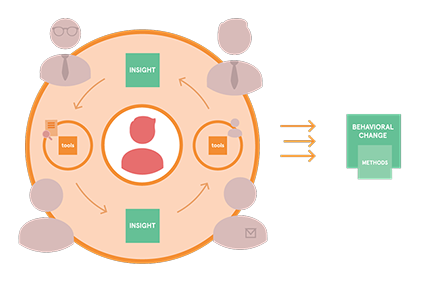
A schematic overview of how I see my way of working. I will facilitate a iterative, co-creating process in a multi-stakeholder context that will alternate between making tools and doing research. Eventually this should result in a change of behaviour for the parties involved.

Tom van 't Westeinde // 2015