
Activities
Designing Social Interation in Neighbourhoods
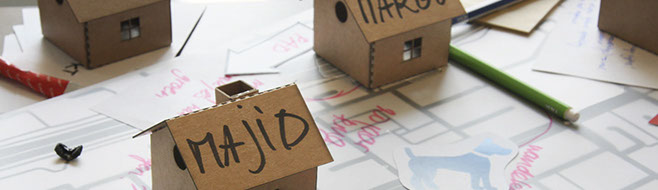
With this project the aim was to elicit social interaction through design interventions in the neighbourhood of Eckart/Vaartbroek in Eindhoven, The Netherlands. Within this area it was explored how multi-directional learning between students* could result in a design that could facilitate the co-creation of healthy living solutions for the inhabitants. Trough experimenting with engagement catalysers, embodiment and by connecting to a diverse group of people it is possible to come up with solutions for societal challenges. This has led to a final concept called ‘Trigger-Gather-Connect’. This service consists of a three step method that aims at bringing people together by focussing on stimulating reminiscence to think about the future.
This project was the major activity of the semester that would determine my development. It has influenced my identity search in the sense that I could discover how my renewed vision and identity could develop into something that was close to reality. I started this by doing research in related work so I could identify myself with other's people work, thoughts and beliefs. I have explored different methodologies to shape an understanding of neighbourhood dynamics and found out which tools and approaches work best. This helped to position myself in a more concrete role as I show in my growth. The multidisciplinary approach has showed me how I can use my social and communication skills to combine different perspectives. It was good to see how these ways of collaborating can be very well facilitated by a design approach. Finally it has also shown my weaknesses when I work alone and what the consequences are of my naivety and sensitivity for dissapointment. I reflect on this in my growth.
PROJECT
Project Report
Coach Feedback
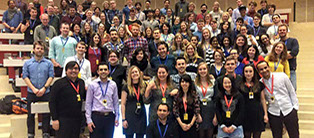
I go the chance to present my research paper of my M1.1. semester at a student conference in Denmark. This two day event was a combination of lectures and workshop with the main goal to get familiar with the subject of embodied interaction. It is very nice to meet other people that share your beliefs and see how they applied that in their work. I have expanded my knowledge and network in the field of social design and explored how I can contribute to the world of design research.
EXTRA CURRICULAR
IDEO HCD Course
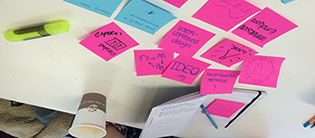
This 7 week online course was centred around the Human Centred Design methods as ideo.org has developed them. For me it was not so much about learning these methods since they are close to what I learn in my own studies. The main element I got out of this was the confirmation of how my own skills can be valuable in combination with these theories and use a design method that gains more and more recognition worldwide. Together with my team we created a concept that could help integrate Chinese people in the Netherlands.
EXTRA CURRICULAR
TEDx conference
For the Dutch Design Week 2015 I am organizing a conference for students and professionals in the format of a TEDx event. As chairman I get the change to challenge my teamwork and communication skills while composing a program that will strongly reflect my own beliefs in regard to the role of design in nowadays society. In this way it helps my own development and compensate the aspect I missed during the Planning for a Design Start-up module.
Proposal
EXTRA CURRICULAR
Tante Netty Creative Pool
As part of the think tank of social design collective Tante Netty I get the change to think along about concrete social projects in and around the neighbourhood of Woensel West in Eindhoven. I can see how my theoretical approach can contribute to the reorganisation of the collective to a more serious and influential organisation. For the Dutch Design Week I will do a project with homeless people in Eindhoven to show the residents of Eindhoven their stories and perspectives on the city.
EXTRA CURRICULAR
Poetry in Design
When I design I like to focus on the experience and affect a product or object has. This module allowed me to experiment with these kind of qualities as a starting point for a design process.
We used the abstract notions of a poem to re-design an existing product. To deal with this abstraction I liked to use methods and theories to structure the process and communicate to others. However it is good that I learned to create a clear vision on the process I have to be aware that this not effect the end result. The constant reflecting on the theoretical steps and how they influenced the next made that we lost some richness in the final design. On the other side this module has taught me how to approach a design process in a different, richer, way that adds great value to a human centred design attitude.
MODULE DB424
Mental Models
With this module I wanted to broaden my interest in the workings of the human brain. As I believe psychology is an important aspect of design I wanted to see if my basic knowledge in social psychology could be broadened with new knowledge.
As I state in my reflection I had difficulties with setting boundaries while exploring all the theory. It was very exhausting for me to deal with the complexity and maintain a structure in all the aspects I was discovering during the module. This resulted in a quite broad understanding of the topic but, as the feedback stated, misses a level of depth in the documentation. As can be seen in my growth this is something I have been working on, but since this module was the first of the semester this could not yet be reached.
Luckily I was able to make a connection to the aspects of human centred design and see the value of theory for my own development.
Module Report
Reflection
Feedback
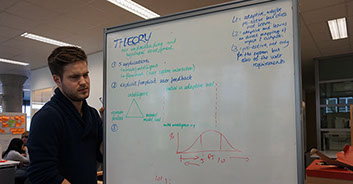
MODULE DB304
Planning for a Design Start-up
Furthermore I have found an interesting link to the growing field of data driven design and my own interest in social design. The sensitivity that comes when dealing with personal (health) data lends itself to dive into people's behaviour and opinions. Aspects of social design can be helpful when exploring people's attitude towards privacy and willingness to share that you encounter when you want to make money out of data.
The video below is a recording of our final presentation. It describes how we see the potential of family dynamics combined with a set of products to gain more insight in how individuals influence each other's patterns and behaviour.
Module Report
Reflection
Feedback
Although the business perspective of design is not my strongest suit it was time for me to start exploring how social design can fit within a sustainable business model. However, I am honest when I say that I had to majorly adapt my expectation of the module once it became known that we would work for Philips in a health and medical context. In this way I could not fully explore the potential of my design identity in regard to concrete business cases.
Luckily the module started with doing a business case analysis of a start-up that was related to a project that could have been done at our faculty. This was followed up by the theory of hypothesis driven entrepreneurship as main theory of the module. With this new knowledge a product of Philips, based on data gathering, could be brought onto the market.
I noticed that during the iterative thinking the very valuable thought processes that result from research and discussions are difficult to communicate to others. Because of this I found it important to focus on clear and visual story during the final presentation. This has resulted in a holistic story but missed the core examples of the concept. It showed me that I have to pay attention to the balance that is necessary in this short timespan in order to touch upon the essential aspects.
MODULE DB520

Tom van 't Westeinde // 2015